Last night, a plumber from Manchester overturned a 13,000-vote Labour majority in one of England’s most deprived constituencies.[1] She didn’t do it with billionaire donors or party machine money. She did it with volunteers, crowdfunding, and people who were sick of being bled dry.
If that doesn’t tell you something about where money should be going, nothing will.
What just happened in Gorton — and why it matters for your money
Hannah Spencer — a plumber, trainee plasterer, and local councillor — just became Greater Manchester’s first Green MP.[2] She took Gorton and Denton with 40.7% of the vote, pushing Labour into third place behind Reform.[1] A seat Labour had held for nearly a century. Gone.
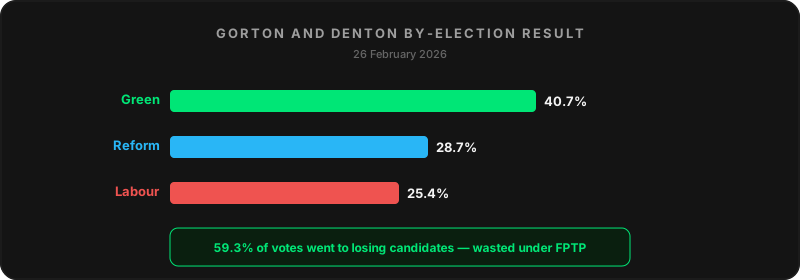
Gorton and Denton by-election result:
— Britain Elects (@BritainElects) February 27, 2026
GRN: 40.7% (+27.5)
REF: 28.7% (+14.7)
LAB: 25.4% (-25.3)
CON: 1.9% (-6.0)
LDEM: 1.8% (-2.1)
Green GAIN from Labour.
Her victory speech didn’t centre culture wars or party tribalism. It centred wealth extraction. “Hard working people are being bled dry,” she said. “We are sick of our hard work making other people rich.”[3]
Look at the constituency she now represents. Gorton and Denton is among the most deprived areas in England. Child poverty runs above 45%. Manchester has boomed over the past two decades — cranes on every corner, billions flowing into the city centre. Gorton hasn’t seen a penny of it.
This is what the financial system produces. Growth happens. Capital flows. But it flows upward and outward, concentrating in the places that already have the most. Gorton is what happens when your capital waters someone else’s field.
The result wasn’t just a political earthquake. It was a signal about money — where it comes from, where it goes, and who gets to decide.
The two ways your money shapes politics
Most people think political change happens at the ballot box. It does. But your money votes every single day — and it votes in two directions.
The first: where your savings, pension, and investments sit determines what kind of economy gets built. If your pension fund owns shares in companies that extract wealth from communities like Gorton, you’re part of the plumbing — whether you know it or not. That’s the core argument we’ve laid out across this site, from what’s wrong with the financial system to impact investing for beginners.
The second — and the focus of this article — is more direct. Your money can fund the grassroots organisations and movements that shift political outcomes. Not party donations to a central machine. Not writing cheques to politicians who forget your name the moment they’re elected. Strategic funding of the infrastructure that makes results like Gorton possible.
This is how you build a better financial system. Not just by redirecting your pension. By redirecting your political capital too.
How grassroots funding actually wins elections
Spencer’s campaign was built on volunteers, small donations via Crowdfunder, and ground-level organising. Reform outspent. The Greens out-organised. Tactical voting groups — including Forward Democracy’s StopReformUK.vote — urged anti-Reform voters to back Spencer,[4] and the numbers suggest they listened.
✅ Tactical voting organisations
— The Green Party (@TheGreenParty) February 21, 2026
✅ Doorstep data
✅ Constituency polling
It's clearer than ever that it's Green vs Reform in Gorton and Denton.
A vote for Hannah Spencer is the only way to stop Reform's hate and make hope normal again. pic.twitter.com/nbVfRvVIdF
This wasn’t a fluke. It’s a model. And it’s been working across the country.
Compass and the “Win As One” campaign. At the 2024 general election, the cross-party organisation Compass endorsed 41 candidates and won 35 of them — an 85% success rate. Their local groups delivered over 100,000 leaflets. Their vote-swap programme covered 425 constituencies — roughly 65% of the country.[5] All funded by small donors and members. Not a single billionaire in sight.
Tactical voting infrastructure at local level. Compass local groups in Canterbury flipped a 20-year Tory council through coordinated tactical voting campaigns. In Oxfordshire, similar groups flipped the last Conservative-held council in the county through letter-writing and street stalls. Forward Democracy built tactical voting tools used by over 700,000 people across the 2023 and 2024 election cycles.[6] In Gorton and Denton, their recommendation to vote Green — based on constituency polling showing more Labour voters willing to switch Green than the reverse[7] — contributed directly to Spencer’s margin.
The key insight: under first-past-the-post, where your political money goes matters enormously. A few hundred pounds directed to the right local campaign can flip a seat. This isn’t idealism. It’s capital allocation applied to democracy. And the return on investment is better than most things in your portfolio.
The organisations worth funding
This isn’t a comprehensive list. It’s a starting framework for anyone who wants to put money where it counts.
Compass — A cross-party organisation focused on progressive cooperation and tactical voting. Runs local groups across the country, endorses candidates, and coordinates vote swaps. Currently mobilising for the May 2026 local elections across England, Wales, and Scotland. Their 85% win rate at the last general election isn’t a slogan — it’s an auditable track record.[5]
Make Votes Matter — The single-issue campaign for proportional representation, with over 100,000 supporters. They’re the co-secretariat of the All-Party Parliamentary Group for Fair Elections — the largest APPG in Parliament, with 150 members, roughly half of them Labour MPs.[8] If PR happens in this country, these are the people who will have pushed it over the line.
Electoral Reform Society — The world’s oldest electoral reform campaign, founded in 1884. Produces research, MP briefings, and public education on proportional representation. Currently pushing the Representation of the People Bill. They’ve been at this for 142 years. They know the terrain.
Crowdfunder political campaigns — The platform where individual candidates raise funds directly from supporters. Spencer’s Gorton campaign used it. So did dozens of others at the last general election. You can fund specific local candidates aligned with your values — no party membership required, no central office skimming a cut.
Forward Democracy / StopReformUK.vote — Tactical voting infrastructure specifically designed to prevent far-right electoral gains. Over 700,000 people used their tools in the last two election cycles.[6] They don’t tell you who to vote for. They tell you which vote counts the most in your constituency.
The Muslim Vote — A volunteer-led coalition that mobilises Muslim voters at the grassroots. At the 2024 general election, TMV-endorsed candidates received 462,728 votes and won four seats — all in previously safe Labour constituencies.[15] In Gorton and Denton, they endorsed the Greens, calling them the “only credible option.”[16] In constituencies with significant Muslim populations, this is one of the most effective grassroots mobilisation operations in the country.
Citizens UK / Greater Manchester Citizens — The UK’s largest community organising network, working through mosques, churches, gurdwaras, trade unions, and schools. The Greater Manchester chapter holds accountability assemblies with local power-holders — putting elected officials in a room with hundreds of constituents and making them answer direct questions. Funded by institutional membership dues, not billionaire donors. This is what permanent grassroots democratic infrastructure looks like.
MEND (Muslim Engagement and Development) — Builds political literacy in Muslim communities through masterclasses, electoral engagement campaigns, and constituency-level briefings. Non-partisan — they don’t tell you who to vote for, they teach you how the system works and how to hold it accountable. In a constituency like Gorton and Denton, that kind of civic infrastructure matters more than any single election.
Church Action on Poverty — Headquartered in Salford, Manchester. Founded in 1982. Their “People’s Budget” campaign helps citizens directly influence local council spending decisions — the decisions that determine whether places like Gorton see investment or neglect. They supported the Manchester Poverty Truth Commission, putting people with direct experience of poverty at the centre of policy conversations.
Near Neighbours — Provides small grants — £250 to £3,000 — for local interfaith community projects. Has a Greater Manchester hub. Money goes directly to grassroots projects that bring together people across religious and ethnic lines. If you want to fund community building at the most local level possible, this is the mechanism.
A note for readers: this isn’t about picking a party. It’s about funding the democratic infrastructure and community organising that makes your vote — and everyone else’s — actually count.
The structural fix: why proportional representation matters
The maths of Gorton tell the story clearly. Spencer won with 40.7% of the vote. That means 59.3% of voters in the constituency didn’t vote for the winning candidate. Their votes are gone. Absorbed into a system that converts them into nothing.
Under proportional representation, every vote would count proportionally. No more “safe seats” built on voter inertia. No more tactical voting because your actual preference is a “wasted vote.” No more pretending that a system designed in the 18th century is fit for a 21st-century democracy.
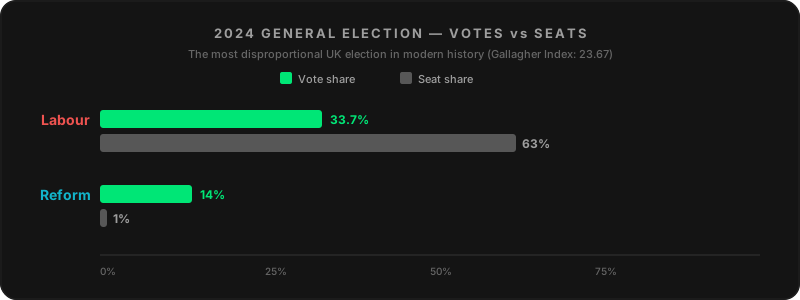
The 2024 general election laid the absurdity bare. It was the most disproportional election in modern British history — a Gallagher Index of 23.67, making it the fifth least proportional result anywhere in the world that year.[9] Labour won 63% of seats with just 33.7% of the vote. They increased their vote share by 1.6 percentage points and doubled their seats.[10] Reform got 14% of the vote and 1% of seats. The system doesn’t just distort outcomes — it makes entire sections of the electorate invisible.
The public knows. The British Social Attitudes survey — published in February 2026 by NatCen — shows 60% of people now want to change the voting system. That’s a record high, up from 53% the year before. Support has risen across every party: 90% of Green voters, 78% of Reform voters, 56% of Lib Dems, 55% of Labour, and — for the first time — 52% of Conservative voters, doubled from 24% in a single year.[11]
In December 2024, the House of Commons backed proportional representation for the first time in history. Sarah Olney’s Ten Minute Rule Bill passed 138 to 136 — by just two votes, with cross-party support.[12] The government refused to allocate parliamentary time for it to progress. But the direction is unmistakable. This is closer than most people realise.
What happened last time — and why it failed
“But we already had a referendum on this. And we voted No.”
That framing is misleading. Deliberately so.
The 2011 referendum wasn’t on proportional representation. It was on the Alternative Vote — a system even Nick Clegg, its supposed champion, called a “miserable little compromise.” AV is not proportional. It’s a majoritarian system that can produce results even more distorted than first-past-the-post. The referendum asked voters to choose between a broken system and a slightly differently broken system, then declared the result proof that nobody wanted change.
The Conservatives offered AV instead of PR precisely because it was easier to defeat. And they made sure it was defeated.
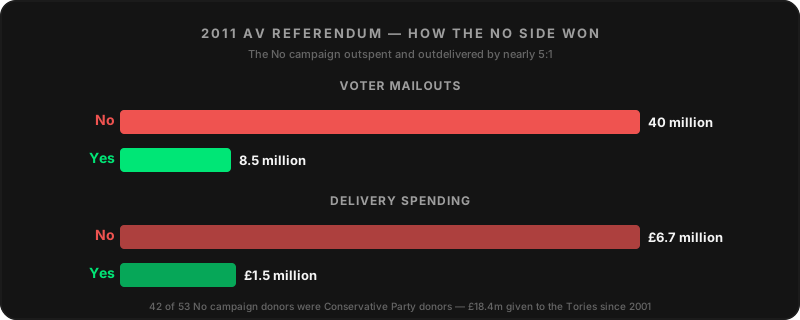
The No campaign outspent Yes nearly five to one on voter mailouts — 40 million deliveries versus 8.5 million. The cost difference was equally stark: the No camp spent £6.7 million on deliveries alone, compared to £1.5 million from the Yes side.[13] Forty-two of the No campaign’s 53 named donors were Conservative Party donors who had collectively given £18.4 million to the Tories since 2001.[14] The same donor networks and campaign strategists who defeated AV later powered the Leave campaign in 2016. The playbook was identical: overwhelming funding, emotional messaging, and a question framed to favour the status quo.
Clegg’s personal unpopularity after the tuition fees U-turn made the referendum a proxy punishment vote rather than a genuine deliberation on voting systems. Most voters weren’t weighing up electoral mechanics. They were punishing a man who’d broken his most visible promise.
The result: 67.9% voted No, on a 42% turnout.[13] David Cameron declared the public had rejected electoral reform “for a generation.”
But here’s what actually happened. The public didn’t reject PR. They rejected a bad compromise, sold badly, by an unpopular figure, against a well-funded opposition. The conditions today are entirely different. Public support for change is at a record high. The APPG has 150 parliamentary members. The House of Commons has already voted in favour. The arguments that locked the 2011 result in place no longer hold.
What you can do this week
This is the part where knowledge turns into action.
Donate to one of the organisations above. Even small amounts matter at this scale. Compass runs live campaigns in every local election cycle. Make Votes Matter and the Electoral Reform Society are pushing legislation through Parliament right now. A few hundred pounds to the right local campaign — via Crowdfunder or directly — can change an outcome. This is capital allocation with a tangible democratic return.
Check where your pension is invested. If your retirement savings are funding the extractive economy that produces places like Gorton — fossil fuels, arms, wealth concentration — consider switching. Your pension is your biggest investment and your most powerful financial lever. Here’s where to start.
Register to vote in the May 7th 2026 local elections. These are the elections where your vote — and your money — have the most leverage. Local councils control planning, housing, and community investment. The decisions that shape places like Gorton happen here, not in Westminster.
Sign the Make Votes Matter petition for proportional representation. 150 MPs already back it. The House of Commons has voted for it. Public support is at 60% and climbing. The pressure needs to keep building until the government can’t ignore it.
Join the EFG community for ongoing guidance on aligning your finances with your values.
Share this article. The biggest barrier to change isn’t opposition. It’s the assumption that nothing can be done. Gorton and Denton just proved that wrong.
This is part of our series on how to build a better financial system. If you want to stay informed, join the community.
References
[1] Manchester City Council, “Parliamentary Gorton and Denton By-Election — 26 February 2026”
[2] Green Party, “Greens pick local plumber to win Gorton & Denton”, 30 January 2026
[3] LBC, “Gorton and Denton by-election: Hannah Spencer victory speech”, 27 February 2026
[4] Green Party, “Tactical voting organisations urge anti-Reform voters to vote Green in Gorton and Denton by-election”, 21 February 2026
[5] Compass, “Win As One — 2024 General Election Campaign”
[6] Forward Democracy / StopReformUK.vote, “About”
[7] Byline Times, “Exclusive poll: anti-Reform tactical voters poised to defeat Nigel Farage’s party in Gorton and Denton by-election”, 24 February 2026
[8] Make Votes Matter, “APPG for Fair Elections: a major step forward”, 25 November 2024; Electoral Reform Society, “Almost 100 MPs join new parliamentary group supporting electoral reform”
[9] Nuffield College Oxford, “Understanding the most disproportionate UK election”
[10] Electoral Reform Society, “How many votes did Labour get in 2024?”; House of Commons Library, Research Briefing CBP-10009
[11] NatCen, “British Social Attitudes 43”, February 2026
[12] UK Parliament, Division 52, 3 December 2024; Electoral Reform Society, “MPs vote for proportional representation in victory for public”
[13] openDemocracy, “AV referendum disaster: here’s how Yes money was spent”; Byline Times, “A dry run for Brexit: the 2011 Alternative Vote referendum, ten years on”
[14] Byline Times, “A dry run for Brexit: the 2011 Alternative Vote referendum, ten years on”, 29 March 2021
[15] The Muslim Vote, “About Us”; Wikipedia, “The Muslim Vote”
[16] Politics Home, “Muslim Voter Group To Endorse Greens In Gorton And Denton By-Election”