Most people never ask what’s wrong with the financial system. That’s not an accident. The system is designed so that you don’t ask. You’re born into it, enrolled into it, and told to trust it — all before anyone explains how it actually works.
And here’s the thing: the financial system doesn’t have a PR problem. It has something much more useful than good PR. It has invisibility. The people it harms the most are the ones least likely to realise they’re being harmed. Your money disappears into a machine every month — pension contributions, savings accounts, index funds — and you’re told that’s just how it works. That it’s working for you.
But is it?
The modern financial system
Let’s start with something most people have never been told plainly: the entire modern financial system is built on fractional reserve banking. That sounds complicated. It isn’t.
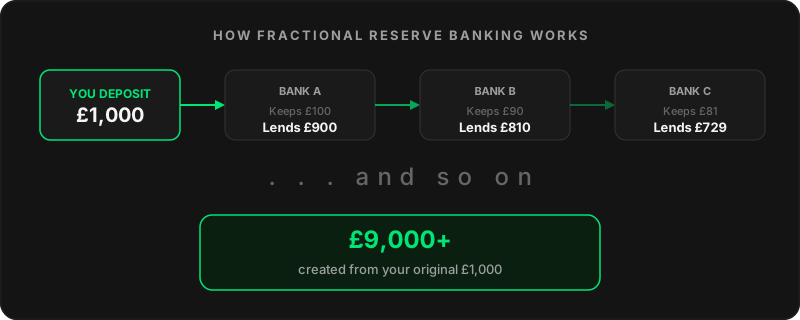
Here’s how it works. When you deposit £1,000 into your bank account, the bank doesn’t put that money in a vault and wait for you to come back. It keeps a fraction — say 10% — and lends out the rest. That £900 gets deposited somewhere else, and that bank lends out 90% of that. And so on, and so on. Your original £1,000 can generate £9,000 or more in new money circulating through the system.[1]
That’s not a conspiracy theory. That’s just how banking works. It’s taught in first-year economics. But nobody teaches it in school. Nobody mentions it when you open your first current account.
What this means in practice is that banks don’t just hold your money. They use it. They use it to create more money, to lend, to invest, to speculate. And the entire structure is propped up by the legal system — regulations, central bank guarantees, deposit insurance — all designed to keep the machine running smoothly enough that you never feel the need to look under the hood.
The system isn’t broken in the way a car breaks down. It’s working exactly as designed. The question is: who was it designed for?
Where the money actually flows
Here’s what most people assume: when a bank lends money, it goes to people and businesses that need it. The shopkeeper expanding her store. The family buying their first home. The startup trying to build something new.
Some of it does. But most of it doesn’t.
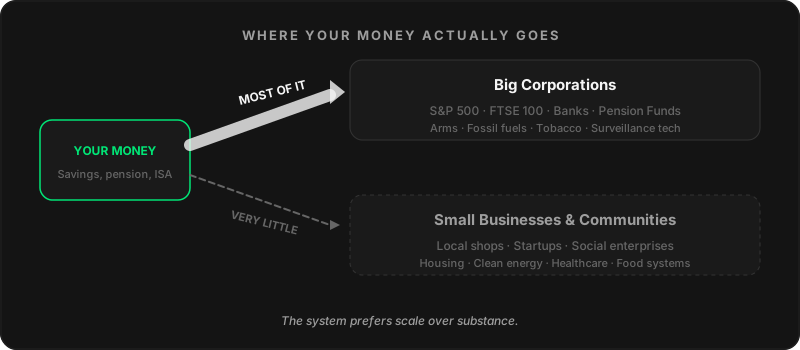
Banks would rather lend to other banks. To pension funds. To large corporations listed on the FTSE 100 or S&P 500. To financial instruments that generate predictable returns at scale. The shopkeeper trying to grow her business? She’s a risk. A line item that doesn’t fit neatly into the model.
The system prefers scale over substance. It’s easier and more profitable to funnel billions into the same 500 companies that already dominate the market than to underwrite a thousand small businesses that might actually create something new. So that’s what happens. Your savings, your pension, your ISA — they all flow upward and inward, concentrating in the same places, inflating the same assets, rewarding the same people.
True value creation — the kind that builds communities, funds innovation, and creates real jobs — gets starved of capital. Not because it’s not viable. Because the plumbing of the system wasn’t built to reach it.
What you’re inadvertently funding
Now let’s talk about what your money is actually doing once it enters the machine.
If you have a workplace pension — and if you’re employed in the UK, you almost certainly do — your money is invested in a default fund. That fund typically tracks a broad market index. Which means your retirement savings own a tiny slice of thousands of companies. All of them. No filter. No questions asked.
That includes arms manufacturers like BAE Systems and Lockheed Martin. Fossil fuel giants like Shell and ExxonMobil. Tobacco companies like Philip Morris and British American Tobacco. Surveillance technology firms. Companies with records of labour exploitation, environmental destruction, and tax avoidance.
None of this is a secret. It’s all in the fund factsheet — the one you’ve never read, because nobody told you it existed. (If you want to check yours, we wrote a step-by-step guide: Where Does Your Pension Money Actually Go?)
The uncomfortable truth is that “passive” investing isn’t passive at all. Every pound you put into an index fund is an active decision to fund everything in that index. The S&P 500 isn’t neutral. The FTSE All-Share isn’t neutral. They’re portfolios assembled by market capitalisation — which means the biggest companies get the most of your money, regardless of what they do or how they do it.
You didn’t choose to fund these things. But your money is funding them right now.
The wealth concentration machine
This is where it gets structural.
The financial system doesn’t just fund questionable things. It actively concentrates wealth in the hands of a shrinking number of people. And it does this by design, not by accident.
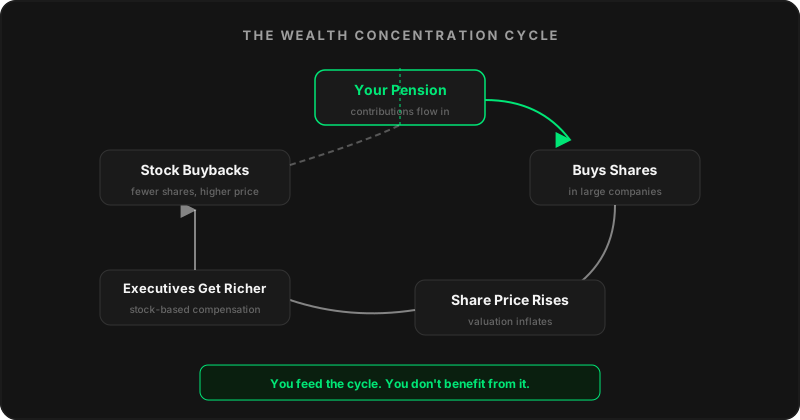
Here’s how. When your pension fund buys shares in a large company, it pushes the share price up — even marginally. The people who benefit most from rising share prices are the people who already own the most shares: executives, founders, and institutional investors. Many executives receive the majority of their compensation in stock. So when your pension money inflates their company’s valuation, you’re directly increasing their personal wealth.
Then there are stock buybacks. Companies spend hundreds of billions every year buying back their own shares. This reduces the number of shares in circulation, which makes each remaining share worth more. Who benefits? The largest shareholders. Who funded the buyback? Often, the same pool of pension and index fund money that includes yours.
Meanwhile, wages have barely kept pace with inflation for decades. Productivity has gone up. Profits have gone up. Executive pay has gone up. But the average worker’s real income? Flat. The gap between what the market returns and what ordinary people experience is not a mystery. It’s a direct consequence of how the system is wired.
“The rich get richer” isn’t a cliché. It’s an accurate description of a system that routes the majority of returns to the people who already have the most capital. Your pension contributions are part of that routing mechanism. You’re feeding the machine — and the machine isn’t feeding you back.
Watering new fields
So what do we do about it?
The answer isn’t to burn the system down. It’s to build new plumbing.
Right now, capital flows through a narrow set of pipes — from your bank account to the same handful of massive funds, into the same overvalued companies, enriching the same small group of people. The infrastructure for anything else barely exists. If you want to invest in affordable housing in your city, or a renewable energy co-operative, or a community land trust — good luck finding a platform that makes it as easy as opening a stocks and shares ISA.
That’s the problem we need to solve. Not just complaining about where the money goes, but building the channels so it can go somewhere better.
Think of it as watering new fields. The old fields are already flooded — the S&P 500 doesn’t need more of your money. But there are entire areas of the economy that are parched: community infrastructure, social housing, clean energy, local food systems, healthcare innovation. Capital could flow there. It just doesn’t, because the pipes don’t exist yet.
Creating those pipes — the platforms, the funds, the regulatory frameworks, the financial products — is the real work. And it’s already started. Community Development Finance Institutions (CDFIs) are lending to underserved businesses. Social impact bonds are funding preventative healthcare. Community energy schemes are financing solar farms owned by the people who use the power. The infrastructure is being built. It just needs more water.
What happens when we get this right
Imagine a version of the financial system where your pension doesn’t just grow in a spreadsheet — it builds something. Where your ISA funds a solar installation on a school roof. Where your savings account backs loans to local businesses instead of leveraged bets on currency markets.
This isn’t utopian thinking. It’s a description of what already happens in pockets around the world. The question is whether we scale it.
When capital flows toward true value creation, the effects ripple outward. A community energy project doesn’t just generate electricity — it creates local jobs, reduces energy bills, and keeps profits circulating in the local economy instead of being extracted to distant shareholders. An affordable housing fund doesn’t just provide homes — it stabilises communities, improves health outcomes, and reduces the public cost of homelessness.
The current system extracts value. A better system creates it. And the difference isn’t theoretical — it’s measurable, practical, and already being demonstrated by people who decided to stop waiting for permission.
Does this mean worse returns?
No. And this is the myth that keeps the old system in place.
For decades, the assumption was that investing ethically meant sacrificing returns. That you had to choose between doing good and doing well. It was a convenient story — convenient for the people selling you the same old products.
The data tells a different story. Study after study has shown that sustainable and impact investments perform comparably to — and in many cases outperform — conventional investments. A meta-analysis of over 2,000 studies found that the majority showed a positive relationship between ESG factors and financial performance.[2] The GIIN’s annual investor survey consistently reports that the vast majority of impact investors meet or exceed their return expectations.[3]
Why? Because companies that manage environmental and social risks well tend to be better-run companies. Because the industries of the future — clean energy, sustainable agriculture, healthcare technology — are growth sectors, not charity cases. And because avoiding companies with catastrophic risk exposure (fossil fuel stranded assets, anyone?) turns out to be good financial hygiene.
The idea that you have to choose between returns and impact is the financial equivalent of being told you can’t have your cake and eat it. Except in this case, the cake exists. People are already eating it. You just weren’t invited to the table.
Three investments that actually change things
Let’s make this concrete. Here are three types of investments that generate real returns and real impact — from the personal to the systemic.
1. Community energy schemes
You invest in a local renewable energy project — a solar farm, a wind turbine, a community-owned battery storage system. Your money funds the construction. The project generates electricity, sells it to the grid, and pays you a return.
Micro impact: You earn 4-7% annually while knowing exactly where your money is and what it’s doing. No black box. No mystery holdings.
Macro impact: Community energy projects have powered hundreds of thousands of homes across the UK. They reduce carbon emissions, create local skilled jobs, and generate surplus revenue that’s reinvested into the community — funding energy efficiency upgrades for vulnerable households, educational programmes in schools, and grants for local organisations. Every megawatt of community-owned energy is a megawatt that isn’t enriching a distant utility shareholder.
2. Affordable housing funds
You invest in a fund that finances the construction or renovation of affordable and social housing. The fund acquires or builds properties, rents them at below-market rates, and generates returns through rental income and modest capital appreciation.
Micro impact: Stable, inflation-linked returns — typically 3-6% — backed by a real, tangible asset. Housing doesn’t evaporate in a market crash.
Macro impact: Every affordable home built is a family housed, a waiting list shortened, a community stabilised. Affordable housing reduces pressure on the NHS (housing insecurity is a major driver of mental and physical health problems), lowers government spending on temporary accommodation, and creates construction jobs. It’s one of the highest-impact investments you can make — because a home changes everything.
3. Social enterprise lending
You lend directly to social enterprises — businesses that exist to solve social problems while generating revenue. Think: a company that employs people with criminal records to refurbish electronics, a café chain that trains young people out of unemployment, or a logistics firm that provides fair-wage delivery jobs.
Micro impact: You receive interest on your loan — typically 3-5% — and you can see exactly which businesses your money supports. Many platforms let you choose the enterprises you back.
Macro impact: Social enterprises in the UK employ over two million people.[4] They operate in the hardest-to-reach parts of the economy — the places traditional finance won’t touch. Your capital funds real jobs, real training, and real products that serve communities rather than extract from them. Scale this up, and you’re looking at a parallel economy built on purpose, not just profit.
You get to vote with your money
Every financial decision you make is a vote. Every pound you save, invest, or spend is a signal to the system about what you value.
Right now, most of those votes are being cast on your behalf — by default funds, by algorithms, by institutions that don’t know your name and don’t share your values. But it doesn’t have to be that way.
You can move your pension. You can switch your bank account. You can choose where your ISA goes. You can lend to social enterprises. You can invest in community energy. You can demand transparency from your financial adviser. You can ask questions that the system was designed to make you never think of.
This isn’t about guilt. If you didn’t know how the system worked until now, that’s not your fault — it was built that way on purpose. But now you know. And knowing means the next decision you make with your money is a real choice, not a default.
The financial system won’t fix itself. It doesn’t need to — it’s working exactly as intended for the people it was built to serve. But you have something it didn’t account for: the ability to redirect your capital toward things that actually matter.
Use it. Here’s how to build a better system.
Further reading
This post is the anchor for a series exploring what’s broken in the financial system and what you can do about it. Here’s the full reading list:
- Where Does Your Pension Money Actually Go?
- How Index Funds Quietly Fund Arms Dealers
- Why ESG Is Mostly Greenwashing
- The History of Financial Deregulation, Simply Explained
- How Banks Use Your Savings Overnight
- Who Actually Benefits From the Stock Market?
- What Happens to Your Money in a Recession
- The Hidden Fees Eating Your Returns
- Why Financial Literacy Is Kept Out of Schools
- The Myth of the Neutral Portfolio
This is the anchor of our series on what’s wrong with the financial system. If you want to stay informed, join the community.
References
[1] Bank of England, “Money Creation in the Modern Economy”, Quarterly Bulletin 2014 Q1
[2] Friede, Busch & Bassen, “ESG and Financial Performance: Aggregated Evidence from More than 2000 Empirical Studies”, Journal of Sustainable Finance & Investment, 2015
[3] Global Impact Investing Network, “State of the Market 2024: Trends, Performance and Allocations”
[4] Social Enterprise UK, “No Going Back: State of Social Enterprise Survey 2021”