We’ve already laid out what’s wrong with the financial system. The short version: banks create money from nothing, most of it flows to financial markets rather than the real economy, and the whole machine concentrates wealth at the top while everyone else runs faster to stay in the same place.
That’s the diagnosis. Now for the harder question: what does better actually look like?
Not in some abstract, wouldn’t-it-be-nice way. In a concrete, evidence-based, this-is-already-being-done-elsewhere way. Because the alternatives aren’t theoretical. They exist. Some have been running for decades. And the data on them is remarkably clear.
The money creation problem — and what to do about it
In 2014, the Bank of England published a paper that should have been front-page news. “Money Creation in the Modern Economy” confirmed what most economists had been quietly acknowledging for years: commercial banks create new money every time they make a loan. Not from deposits. Not from reserves. From nothing.[1]
This matters because it means the money supply — the total amount of money circulating in the economy — is determined by lending decisions made by private banks for private profit. Not by any democratic process. Not by any assessment of social need. By whatever a bank thinks will generate the best return for its shareholders.
The question is obvious: should private institutions have the power to create a nation’s money supply?
A growing number of economists, former regulators, and even central bankers say no. And they’ve done the maths.
The alternatives on the table
The Chicago Plan was first proposed in 1933 by economists at the University of Chicago — including Frank Knight and Henry Simons — and championed publicly by Irving Fisher. The core idea: banks must hold 100% reserves against all demand deposits. They can still lend, but only from money that savers have explicitly placed in investment accounts. Money creation becomes the sole responsibility of the central bank.
In 2012, IMF researchers Jaromir Benes and Michael Kumhof revisited the plan using modern economic modelling. Their findings were striking: output gains approaching 10%, the complete elimination of bank runs, and a dramatic reduction in both public and private debt. All four of Fisher’s original claims were validated.[2]
Positive Money, a UK think tank founded in 2010, takes this further. Their sovereign money proposal would give the Bank of England a monopoly on money creation — including electronic money, not just physical cash. New money would enter the economy through government spending or a citizens’ dividend, decided through a transparent, democratic process. Banks would become pure intermediaries: connecting savers to borrowers, but never creating money themselves.
This isn’t a fringe position. Martin Wolf, chief economics commentator at the Financial Times, endorsed the proposal in 2014.[3] In November of that year, the UK Parliament debated money creation for the first time in 170 years — directly prompted by Positive Money’s campaign.[4] The organisation’s founder, Ben Dyson, later joined the Bank of England to work on central bank digital currency research.
Switzerland put it to a vote. In 2018, the Vollgeld (Sovereign Money) Initiative went to a national referendum — the first time any country had put the question of money creation to a direct popular vote. It was defeated, with 75.7% voting against. But 442,000 Swiss citizens voted for fundamental monetary reform.[5]
Iceland went even further on paper. In 2015, a member of parliament published a report commissioned by the Prime Minister examining sovereign money for Iceland. The key finding: Icelandic banks had expanded the money supply nineteen-fold in the fourteen years before the 2008 crisis — up to six times more than the economy needed.[6]
| Approach | Core change | Key evidence | Status |
|---|---|---|---|
| Chicago Plan (1933 / IMF 2012) | 100% reserves on demand deposits; central bank controls money supply | IMF model: ~10% output gains, elimination of bank runs, major debt reduction | Academic; no adoption |
| Sovereign money (Positive Money) | Central bank monopoly on all money creation | Endorsed by Martin Wolf (FT); prompted first UK Parliament debate on money creation in 170 years | Active campaign; growing policy influence |
| Vollgeld Initiative (Switzerland 2018) | Swiss National Bank sole money creator | First national vote on sovereign money; 442K voted yes | Defeated 75.7% — but proved public appetite exists |
| Iceland sovereign money report (2015) | Separate money creation from money allocation | Money supply grew 19x in 14 years pre-crisis | Government-commissioned; further study recommended |
| Central bank digital currency (multiple countries) | Citizens hold digital money directly at the central bank | Could structurally bypass fractional reserve banking | Actively piloted globally; most “mainstream” reform vector |
The quiet revolution: CBDCs
Here’s where it gets interesting. Central bank digital currencies — digital money held directly by citizens at the central bank — could achieve much of what sovereign money advocates want, without anyone having to win a referendum.
If you can hold money directly at the Bank of England, you no longer need a commercial bank deposit for everyday transactions. The bank’s role in money creation is structurally reduced. This is precisely why most CBDC designs deliberately limit how much you can hold — the ECB’s proposed digital euro caps holdings at 3,000 euros per person.[7] They know that an unrestricted CBDC would fundamentally reshape banking.
Lord Adair Turner, former chairman of the UK Financial Services Authority, goes further still. In Between Debt and the Devil, he argues governments should, in certain conditions, finance spending directly with central bank money creation rather than through borrowing.[8]
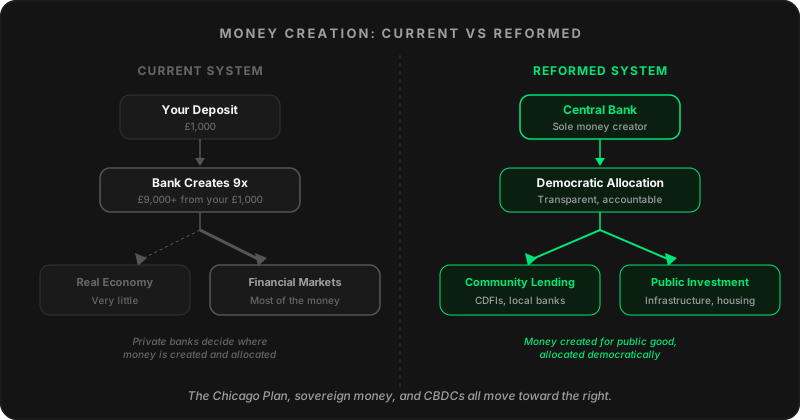
None of these proposals are perfect. Critics argue they could reduce credit availability, drive activity into shadow banking, or give governments too much control over the money supply. These are legitimate concerns that need working through. But the status quo — where private banks control the money supply with no democratic mandate — isn’t a neutral position. It’s a choice. And the evidence increasingly suggests it’s not a very good one.
Financial products that could change everything
Reforming money creation is the structural change. But there’s a more immediate question: what financial products could exist — right now — to channel money toward real-world value instead of financial speculation?
Some already exist. Others are emerging. A few are being actively discussed at the highest levels of UK financial regulation.
Your pension could fund your home
In Australia, the First Home Super Saver Scheme lets people make voluntary contributions to their pension fund and then withdraw them for a first home deposit. By 2021-22, 12,500 Australians had used it, withdrawing AUD $141.7 million.[9] In Singapore, the Central Provident Fund — a mandatory savings scheme — can be used directly for housing. Over 4.3 million members hold more than SGD $635 billion, and most use it to pay their mortgage.[10]
The UK doesn’t allow this. But in March 2025, FCA chief executive Nikhil Rathi publicly raised the question at the JP Morgan Pensions and Savings Symposium.[11] Five other countries already allow some form of pension-to-housing. Why not the UK?
The trade-offs are real — early withdrawal reduces retirement savings, and injecting more money into housing could push prices higher. But the principle is worth examining: why should your pension only be allowed to fund financial markets? Why can’t it fund the roof over your head?
Tax wrappers that reward real impact
The Innovative Finance ISA, introduced in 2016, lets you invest tax-free in peer-to-peer lending, crowdfunding bonds, and direct loans to social enterprises. Platforms like Ethex have raised over £120 million through it.[12] Triodos Bank offers an IFISA for investing in organisations delivering social, environmental, or cultural impact.
Community Investment Tax Relief gives 25% tax relief over five years on investments in accredited CDFIs — the community lenders who serve people mainstream banks reject. Investment through CITR grew from £13.1 million in 2023 to £63.4 million in 2024.[13] Nearly five times more capital flowing to community lenders in a single year.
But not everything has worked. Social Investment Tax Relief — which offered 30% income tax relief on investments in social enterprises — was quietly closed in April 2023 after raising just £15 million over its lifetime against a target of £83 million. Three-quarters of organisations reported difficulty using it, citing unclear guidance, complex rules, and limited capacity.[14] The lesson: good intentions without good design don’t create good outcomes.
| Product | How it works | Key stat | Status |
|---|---|---|---|
| Pension-to-housing (Australia, Singapore) | Withdraw pension contributions for a first home deposit | 12,500 Australians used it; SGD $635bn in Singapore’s CPF | Active abroad; under discussion in UK |
| Innovative Finance ISA | Tax-free investment in P2P lending, social enterprises, community projects | Ethex raised £120m+; Triodos deployed £8.5bn in impact loans | Active in UK |
| Community Investment Tax Relief | 25% tax relief on investments in accredited CDFIs | Grew from £13.1m to £63.4m in one year (2023-24) | Active; growing fast |
| Social Impact Bonds | Private capital funds social programmes; government pays on outcomes | 276 projects globally; UK’s £500m Better Futures Fund | Active; UK pioneered (2010) |
| Green/social bonds | Debt instruments funding specific environmental or social projects | $966bn global issuance in 2024 | Mainstream; UK largest sovereign issuer |
| Social Investment Tax Relief | 30% income tax relief on social enterprise investment | Raised just £15m vs £83m target; closed April 2023 | Failed — lesson in design |
The UK social impact investment market reached £11.2 billion at the end of 2024, growing 12% year-on-year. Half of that — £6 billion — is directed toward social and affordable housing.[15] The infrastructure is being built. The question is whether policy will accelerate it or let it crawl.
What real-world value actually looks like
This is where it stops being abstract. These aren’t hypothetical programmes. They’re running right now, with real money, generating real returns and real impact.
Community lenders: funding who the banks won’t
CDFIs — Community Development Finance Institutions — lent a record £322.6 million in 2024. Ninety-nine percent of the businesses they funded had been turned down by another lender. Ninety-eight percent were based outside London.[16]
They created 6,411 jobs and safeguarded another 5,402. They saved borrowers an average of £340 per loan compared to high-cost lenders — totalling £29 million in household savings. The average personal loan was just £726.[16] This isn’t the headline-grabbing scale of high finance. It’s the scale of real life.
And the capital revolves. Once a CDFI loan is repaid, it’s re-issued to the next borrower. The same money cycles through a community over and over, building prosperity each time it passes through.
Community energy: £1 in, £9 back
Up to £255 million has been invested in solar installations across 250+ schools, 260 NHS sites, and multiple military sites in England — estimated to save £520 million in energy bills over 30 years.[17] In North Lincolnshire, solar panels on 23 buildings saved host sites over £300,000 in three years.[17]
The Joseph Rowntree Foundation found that for every £1 invested in fuel poverty alleviation by community energy organisations, the net social return on investment was £9.[18] Not 9%. Nine times the original investment — when you account for health improvements, reduced NHS costs, and economic activity unlocked by lower energy bills.
The multiplier effect: where your money lands matters
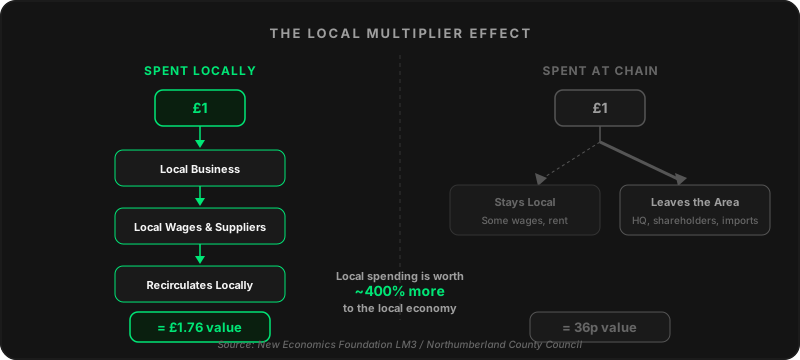
The New Economics Foundation’s research makes this visceral. When Northumberland County Council tracked where money actually went, they found that every £1 spent with a local supplier was worth £1.76 to the local economy. The same £1 spent outside the area was worth just 36 pence locally.[19]
That’s not a marginal difference. Local spending is worth almost 400% more to the local economy than spending that leaves the area. The American Independent Business Alliance found similar results: for every $100 spent at a locally owned business, $68 stays in the community. At a chain, just $43.[20]
| Initiative | What it does | Impact data |
|---|---|---|
| UK CDFIs | Lend to people and businesses banks reject | £322.6m lent in 2024; 99% declined elsewhere; 6,411 jobs created |
| Community energy (UK) | Solar on schools, NHS sites, social housing | £255m invested; £520m lifetime savings; £1 = £9 social return |
| Community land trusts (US) | Permanently affordable housing via shared ownership | Homeowners 10x less likely to default; prices 30-400% below market |
| Local multiplier (NEF) | Tracking where money flows in local economies | £1 locally = £1.76 value; £1 elsewhere = 36p locally |
| Grameen Bank (Bangladesh) | Microlending to the poorest, 94% of villages | 54% of borrowers crossed poverty line; 98% repayment rate |
| Credit unions | Member-owned community finance | Every $1 of assets generates $1.64 in community economic activity |
These aren’t charity programmes. They’re financially self-sustaining models that generate competitive returns while building real prosperity in communities that the mainstream financial system has written off.
What a more equal financial world actually looks like
Here’s where the sceptics dig in. “It sounds nice,” they say, “but equality comes at the cost of growth. You can’t have both.”
The data says otherwise. Comprehensively.
The IMF’s inconvenient findings
In 2015, the International Monetary Fund published research that should have ended the trickle-down debate permanently. Using data from 159 countries over several decades, they found:[21]
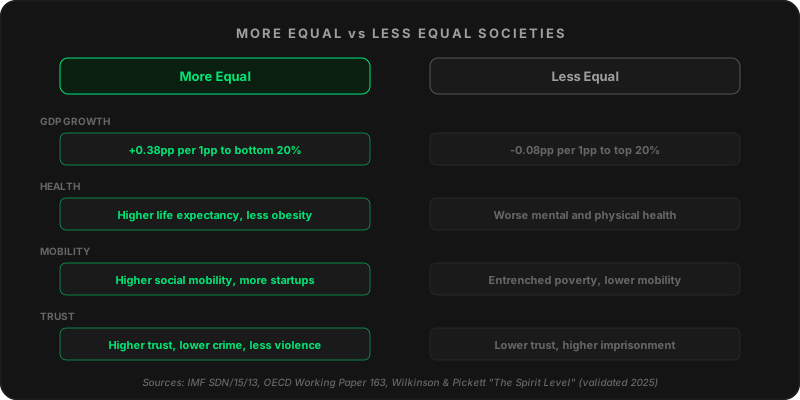
- When the income share of the top 20% increases by 1 percentage point, GDP growth is 0.08 percentage points lower in the following five years.
- When the income share of the bottom 20% increases by 1 percentage point, GDP growth is 0.38 percentage points higher.
Read that again. Wealth flowing to the richest slightly reduces growth. Wealth flowing to the poorest substantially increases it. This isn’t from a left-wing think tank. It’s from the IMF — the institution that spent decades advocating for structural adjustment and austerity.
The OECD reached similar conclusions. Their research found that income inequality has a “negative and statistically significant impact on subsequent growth” across 30 years of data from member countries. The richest 10% in OECD nations now earn 9.5 times the income of the poorest 10% — up from 7:1 in the 1980s.[22]
The Spirit Level: inequality harms everyone
Wilkinson and Pickett’s landmark study — updated and revalidated as recently as 2025 — looked at 23 of the world’s richest countries across 11 health and social metrics: physical health, mental health, drug abuse, education, imprisonment, obesity, social mobility, trust, violence, teenage pregnancies, and child well-being.[23]
In every case, outcomes were significantly worse in more unequal societies. Not just for the poor — for almost everyone. Inequality is a system-level problem, not an individual one.
Real models, real results
These aren’t thought experiments. Countries and organisations have built more equal financial structures, and the results speak for themselves.
| Model | Where | Key feature | Outcome |
|---|---|---|---|
| Sparkassen | Germany | 431 publicly mandated community savings banks | Fund two-thirds of all German SME lending; held stable through 2008 crisis |
| Nordic model | Scandinavia | Coordinated wage bargaining + public investment | Gini 0.27 vs UK 0.36; Norway’s GDP per capita above US; higher startup rates than America |
| Mondragon | Basque Country, Spain | 96 worker-owned cooperatives | Pay ratio 6:1 vs corporate 344:1; €11.6bn in sales; 3.5% of regional GDP |
| Japan Post Bank | Japan | Public postal savings funding national development | 80% of citizens held an account; $2.2tn in deposits; funded infrastructure and SMEs |
Germany’s Sparkassen are particularly instructive. These 431 community savings banks — publicly mandated to serve their regions, not shareholders — hold over a third of German banking assets and provide more than two-thirds of financing for small and medium-sized enterprises.[24] They’re a cornerstone of the Mittelstand, Germany’s world-class industrial base. And they sailed through the 2008 financial crisis with stable profitability while commercial banks collapsed around them.
The Nordic countries consistently rank among the most equal societies on earth, with a Gini coefficient of 0.27 compared to 0.39 in the US and 0.36 in the UK.[22] The standard criticism is that equality comes at the cost of dynamism. The data says the opposite: Norway’s GDP per capita exceeds the US, and startup rates in Norway and Denmark are higher than in America.
Mondragon — a network of 96 worker-owned cooperatives in Spain’s Basque Country — has been operating since 1956. It generates €11.6 billion in annual sales, accounts for 3.5% of regional GDP, and caps its pay ratio at 6:1 between highest and lowest paid.[25] The equivalent ratio in typical US corporations is 344:1. Mondragon’s explicit mission: “The objective of the cooperative is not to produce rich people. It’s to produce rich societies.”
This is what we should aspire to
None of this is utopian. Every example in this article is real. Every statistic is sourced from the IMF, the OECD, the Bank of England, the New Economics Foundation, or the organisations themselves. The Sparkassen have been running for over a century. Mondragon for seven decades. The Nordic model for the better part of a century.
The alternatives to the current financial system aren’t untested ideas scribbled on napkins. They’re proven models with decades of data behind them. The question isn’t whether a better system is possible — it’s why we’re still running the old one.
And this isn’t a left-wing argument. The IMF — hardly a bastion of socialism — says inequality harms growth. The Bank of England admits banks create money from nothing. The Financial Times’ chief economics commentator endorses sovereign money reform. Conservative economists designed the Chicago Plan. Worker-owned cooperatives generate billions in revenue.
This is a pragmatic argument. The current system is measurably worse at generating broad prosperity, stable growth, and community resilience than the alternatives that already exist. Defending it isn’t conservative — it’s just familiar.
The good news is you don’t have to wait for systemic reform. You can start redirecting your money today. Impact investing for beginners breaks down exactly how — from switching your pension to funding community energy.
The system won’t rebuild itself. But you can start building around it.
Further reading
This post is the anchor for a series on building a better financial system. Here’s the full reading list:
- Ethical Banks vs High Street Banks Compared
- How to Move Your Pension to an Ethical Fund
- What Is Divestment and Does It Actually Work?
- Ethical ISAs Explained
- How to Read a Fund’s Holdings
- Switching Your Current Account to an Ethical Bank
- What Does “Sustainable” Actually Mean in Finance?
- Fossil Fuel Free Investing: A Practical Guide
- Should You Invest in Companies to Change Them?
- How to Talk to Your Financial Adviser About Ethics
This is the anchor of our series on what to do about the financial system. If you want to stay informed, join the community.
References
[1] Bank of England, “Money Creation in the Modern Economy”, Quarterly Bulletin 2014 Q1
[2] Benes & Kumhof, “The Chicago Plan Revisited”, IMF Working Paper WP/12/202, August 2012
[3] Martin Wolf, “Strip Private Banks of Their Power to Create Money”, Financial Times, 24 April 2014
[4] Hansard, “Money Creation and Society”, House of Commons debate, 20 November 2014
[5] Vollgeld Initiative, “Sovereign Money Initiative”, Swiss referendum, 10 June 2018
[6] Sigurjónsson, “Monetary Reform: A Better Monetary System for Iceland”, report commissioned by the Prime Minister of Iceland, March 2015
[7] European Central Bank, “A Digital Euro”
[8] Adair Turner, Between Debt and the Devil: Money, Credit, and Fixing Global Finance, Princeton University Press, 2015
[9] Australian Taxation Office, “First Home Super Saver Scheme”
[10] Singapore Central Provident Fund Board, “CPF Overview”
[11] FCA, “The Future of Pensions: Act Today to Plan for Tomorrow”, speech by Nikhil Rathi at JP Morgan Pensions and Savings Symposium, 28 March 2025
[12] Ethex, “About Us”
[13] Responsible Finance, “Community Investment Tax Relief (CITR)”
[14] HM Government, “Social Investment Tax Relief: Call for Evidence”; Better Society Capital, “Social Investment Tax Relief”
[15] Better Society Capital, “Size of the UK Social Impact Investment Market”
[16] Responsible Finance, “Impact Report 2025”
[17] UK Government / Great British Energy, “Community Energy Investment to Build Community Wealth and Power”
[18] Joseph Rowntree Foundation, “Community Energy and Low-Income Households”
[19] New Economics Foundation, “The Money Trail: Measuring Your Impact on the Local Economy Using LM3”
[20] American Independent Business Alliance, “Local Multiplier Effect”
[21] Dabla-Norris et al., “Causes and Consequences of Income Inequality: A Global Perspective”, IMF Staff Discussion Note SDN/15/13, June 2015
[22] OECD, “In It Together: Why Less Inequality Benefits All”, May 2015
[23] Wilkinson & Pickett, The Spirit Level: Why Equality Is Better for Everyone, Penguin, 2010; updated in The Inner Level, 2018
[24] Deutscher Sparkassen- und Giroverband, “Sparkassen-Finanzgruppe”
[25] Mondragon Corporation, “Annual Report”; Co-operative News, “Mondragon Worker Co-op Federation Reports Sales of €11.213bn”