You’ve probably heard that the financial system is broken. That your pension funds arms dealers. That “sustainable” investing is mostly a rebrand. Maybe you’ve even read our breakdown of what’s actually wrong.
But here’s the part that most people never get to: there’s already an alternative. It’s called impact investing, and it’s been quietly growing for over a decade. Not as a protest movement. Not as a niche hobby for the wealthy. As a legitimate, return-generating approach to putting your money to work.
The problem is that almost nobody explains it properly. The industry wraps it in jargon, conflates it with things it’s not, and makes it sound like something you need a financial adviser and six figures to access.
You don’t. Here’s how it actually works.
What impact investing actually is
Impact investing means putting your money into things that generate a financial return and a measurable positive outcome for people or the planet.
That’s it. That’s the whole definition.
| Traditional investing | Impact investing | |
|---|---|---|
| Goal | Maximise financial return | Financial return + measurable social/environmental impact |
| What it funds | Whatever the market rewards | Businesses and projects solving real problems |
| Your role | Passive — you own what the index owns | Intentional — you choose where your money goes |
| Impact measurement | Not considered | Tracked and reported |
It’s not charity. You expect a return. It’s not philanthropy with a stock ticker. It’s a belief — backed by evidence — that you can grow your money without funding the things that are tearing the world apart.
The impact investing market was valued at over $1.1 trillion globally in 2024, according to the Global Impact Investing Network (GIIN). That number is growing at 20%+ per year.[1] This isn’t a fringe movement. It’s a market shift.
Impact vs ESG vs SRI — why the difference matters
These three terms get thrown around interchangeably. They’re not the same thing. The industry likes the confusion because it lets them slap an “ESG” label on a standard fund and charge a premium.
Here’s what each one actually means:
| Approach | What it does | Example | Limitations |
|---|---|---|---|
| ESG (Environmental, Social, Governance) | Rates companies on non-financial risk factors | A fund that scores Shell highly because it has good governance structures | Doesn’t exclude harmful industries. An oil company with a good board still extracts oil. Rating agencies often contradict each other. |
| SRI (Socially Responsible Investing) | Screens out companies that fail ethical tests | A fund that excludes tobacco, weapons, and gambling | Only avoids harm — doesn’t actively seek good. You know what you’re not funding, but not what you are. |
| Impact investing | Intentionally funds solutions to social/environmental problems | Investing in affordable housing, community energy, or social enterprises | Fewer products available. Often less liquid than public markets. Requires more due diligence. |
Think of it as a spectrum:
ESG = “Rate the bad stuff” → SRI = “Avoid the bad stuff” → Impact = “Fund the good stuff”
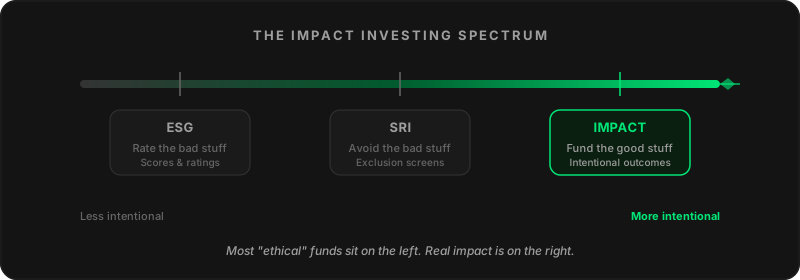
Most “ethical” funds you’ll find on the high street are ESG or SRI at best. They’ll exclude the worst offenders — maybe no tobacco, maybe no cluster munitions — but they’ll still hold fossil fuel companies, big banks, and surveillance tech. If you want your money to actively build something better, you need impact investing.
Does it actually make money?
Yes. This is the question everyone asks first, and the answer is clear.
The GIIN’s 2024 annual survey found that 88% of impact investors reported meeting or exceeding their financial return expectations.[2] A meta-analysis of over 2,000 academic studies found a positive correlation between ESG/impact factors and financial performance in the majority of cases.[3]
Here’s why that makes sense:
| Factor | Why it helps returns |
|---|---|
| Future-facing industries | Clean energy, healthcare tech, and sustainable agriculture are growth sectors — not charity cases |
| Better risk management | Companies that manage environmental and social risks well tend to avoid catastrophic blowups (stranded fossil fuel assets, regulatory fines, reputational damage) |
| Consumer demand | People increasingly prefer sustainable products and services — companies that meet this demand grow faster |
| Regulatory tailwinds | Governments worldwide are tightening emissions standards, mandating disclosures, and subsidising clean energy |
The idea that you have to choose between returns and impact is outdated. It’s the financial equivalent of being told you can’t have a career and a family. People are doing both. The data proves it works.
Typical return ranges by impact investment type:
| Investment type | Typical annual return | Risk level | Liquidity |
|---|---|---|---|
| Impact equity funds | 6-10% | Medium-high | High (publicly traded) |
| Green/social bonds | 3-5% | Low-medium | Medium |
| Community energy | 4-7% | Medium | Low (fixed terms) |
| Affordable housing funds | 3-6% | Low-medium | Low-medium |
| Social enterprise lending | 3-5% | Medium | Low (fixed terms) |
| Community Development Finance (CDFIs) | 2-4% | Low-medium | Low |
These aren’t guaranteed returns — nothing in investing is. But they’re competitive with, and in some cases better than, what you’d get parking your money in a default pension fund.
The spectrum of impact
Impact investing isn’t all-or-nothing. You don’t have to move every penny into a community solar farm tomorrow. There’s a spectrum, and you can start wherever makes sense for you.
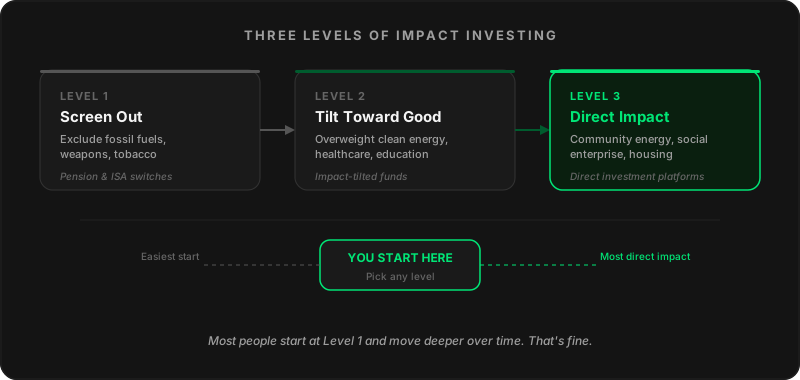
Level 1: Screen out the worst Switch your pension or ISA to a fund that excludes fossil fuels, weapons, tobacco, and gambling. You’re still in public markets, still diversified — you’ve just drawn some lines. Platforms like Big Exchange or your pension provider’s ethical fund options can do this.
Level 2: Tilt toward the better Choose funds that overweight companies solving problems — clean energy, healthcare, education, circular economy. You’re not just avoiding harm, you’re leaning toward good. Funds from providers like Triodos or EQ Investors take this approach.
Level 3: Direct impact Put some of your capital directly into things that build the world you want. Community energy schemes on platforms like Abundance or Ethex. Social enterprise lending through Big Society Capital-backed intermediaries. Affordable housing funds. You can see exactly where your money goes and what it’s doing.
Most people start at Level 1 and move deeper over time. That’s fine. The point is to start.
How it actually works
Let’s demystify the plumbing. Here’s where your money can go and how it gets there:
Public markets (stocks and funds) You buy shares in companies or invest in funds that hold them. Impact equity funds select companies based on both financial and impact criteria. These are the most accessible — available through most investment platforms, ISAs, and pension providers.
Bonds (green bonds, social bonds) You lend money to organisations (governments, companies, development banks) that use it for specific social or environmental projects. A green bond might fund a wind farm. A social bond might fund affordable housing. You get your money back plus interest at the end of the term.
Community finance You invest directly in local projects — solar installations, community land trusts, housing co-operatives. These are typically offered through dedicated platforms and have fixed terms (usually 3-7 years). Returns come from the project’s revenue.
Social enterprise lending You lend directly to businesses that exist to solve social problems. The business uses your capital to grow, pays you interest, and creates social value along the way. Platforms exist that let you choose exactly which enterprises you back.
| Channel | How you access it | Minimum | Typical term |
|---|---|---|---|
| Impact equity funds | Investment platform, ISA, pension | From £1 (some platforms) | Ongoing |
| Green/social bonds | Bond platform or direct from issuer | £100-£1,000 | 3-10 years |
| Community energy | Platforms like Abundance, Ethex | £5-£100 | 3-7 years |
| Social enterprise lending | Specialist platforms | £50-£500 | 1-5 years |
| Ethical bank savings | Open an account | £1 | Ongoing |
How to get started — 5 practical steps
You don’t need to overhaul your entire financial life. Start with one of these. Each one takes less than an hour.
1. Check your pension
Your pension is probably your biggest single investment. Log in, find the name of the fund you’re in, and check if your provider offers an ethical or sustainable option. Most do now. Switching is usually as simple as selecting a different fund in your online portal. Look for funds that explicitly exclude fossil fuels and weapons — not just ones with “ESG” in the name.
2. Switch your bank
Your current account balance is lent out overnight by your bank. High street banks use it for anything and everything. Banks like Triodos, Ecology Building Society, or Nationwide’s ethical options are transparent about where your money goes. Switching takes 7 days under the Current Account Switch Service.
3. Open an ethical ISA
Your annual ISA allowance (£20,000) is one of the most powerful tax-free investment tools you have. Instead of a default stocks and shares ISA, choose one that invests in impact funds. Platforms like Big Exchange, Triodos, or EQ Investors offer these.
4. Try a community investment
Put a small amount — even £50 — into a community energy or social enterprise project through platforms like Abundance or Ethex. This gives you direct visibility into where your money goes and what it’s doing. It’s the best way to understand what impact investing feels like.
5. Ask your financial adviser one question
If you use an adviser, ask them: “Can you show me exactly what my money is invested in, and what it’s funding?” If they can’t answer clearly, or if the answer doesn’t sit well with you, ask them about impact alternatives. If they dismiss the idea, consider finding a new adviser.
The mistakes everyone makes
Impact investing is growing fast, which means there’s a lot of noise. Here’s what to watch out for:
| Mistake | Why it happens | What to do instead |
|---|---|---|
| Trusting “sustainable” labels | The word is unregulated — anyone can use it | Read the fund’s actual holdings, not just the name |
| Not checking fund holdings | Factsheets are buried and boring | Download it anyway — search for fossil fuels, weapons, tobacco |
| Paying too much in fees | Some ethical funds charge a premium | Compare fees. The gap between ethical and conventional funds is closing. Anything over 1% needs justification |
| Thinking small amounts don’t matter | The industry markets to high-net-worth individuals | £50 in community energy creates real impact. Scale comes from millions of people making small moves |
| Waiting for the perfect option | Analysis paralysis — no fund is 100% clean | A good option today beats a perfect option never. You can refine over time |
| Ignoring your pension | It feels abstract and far away | Your pension is likely your largest investment by far. Moving it is the single highest-impact thing you can do |
You don’t need to be rich to do this
The impact investing industry has a branding problem. It sounds like something for people with family offices and seven-figure portfolios. It’s not.
If you have a workplace pension, you’re already an investor. The question is just whether you’re investing with intention or by default.
One pension switch can redirect tens of thousands of pounds over your working life. One bank switch moves your daily balance away from fossil fuel lending. One £50 community energy investment funds a solar panel that powers a school.
None of this requires wealth. It requires awareness — which you now have — and a decision to act on it.
The financial system won’t change itself. It doesn’t need to. But you have something the system didn’t account for: the ability to choose where your money goes.
Start with one step. Any step. The rest follows.
Further reading
This post is the anchor for a series on impact investing. Here’s the full reading list:
- Impact Investing vs ESG vs SRI — What’s the Difference?
- Can You Get Good Returns With Impact Investing?
- How to Screen Investments for Ethics
- Best Impact Investing Platforms in the UK
- Community Development Finance Explained
- What Is Blended Finance and Why Does It Matter?
- Green Bonds: Are They Worth It?
- Social Impact Bonds Explained Simply
- How to Measure the Impact of Your Investments
- The Biggest Myths About Ethical Investing
This is the anchor of our series on investing with impact. If you want to stay informed, join the community.
References
[1] Global Impact Investing Network, “Sizing the Impact Investing Market 2024”
[2] Global Impact Investing Network, “State of the Market 2024: Trends, Performance and Allocations”
[3] Friede, Busch & Bassen, “ESG and Financial Performance: Aggregated Evidence from More than 2000 Empirical Studies”, Journal of Sustainable Finance & Investment, 2015