There are now over 900 funds in the UK that call themselves “sustainable”, “ethical”, or “ESG-aligned”. The ethical product market has exploded. Banks are launching green savings accounts. Pension providers are rushing out “responsible” investment options. Every investment platform has an ethical portfolio tier.
And most of it is noise.
The labelling is a mess. “Sustainable” means whatever a fund manager wants it to mean. “ESG” might mean a fund scores companies on environmental criteria — or it might mean they excluded two tobacco stocks and called it a day. “Ethical” can describe a fund that still holds Shell, BP, and Rio Tinto, as long as they score well on governance.
This is the greenwashing problem. Not the blatant, cartoon-villain kind — though that exists too — but the subtler version where products are marketed as ethical without meaningful criteria behind the label.
So when someone asks “what’s the best ethical bank?” or “which investment platform is actually ethical?”, the honest answer is: it depends on what you mean by ethical, and almost nobody asking the question has been given the tools to answer it.
That’s what this post is for.
This isn’t an affiliate listicle. Nobody pays us to be here. We don’t earn commission from recommending one platform over another. What follows is efg’s honest review framework — how we assess ethical financial products — and our current view of the landscape across banks, platforms, funds, pensions, and ISAs.
If you want to understand what’s actually wrong with the financial system, start there. This post is about what to do with your money once you’ve decided to move it.
Why most “ethical” product lists are useless
Google “best ethical investment platform UK” and you’ll find a dozen listicles within seconds. They look helpful. They’re not.
The affiliate problem. Most comparison sites earn commission when you click through and sign up. The platform paying the highest referral fee gets the top spot — not the most ethical one. The rankings are a sales funnel dressed up as independent advice.
The naming chaos. “Sustainable”, “ESG”, “green”, “responsible”, “ethical” — these words are used interchangeably, but they mean different things. Or nothing at all. There’s no universal standard. A fund can call itself “sustainable” while holding fossil fuel producers. An “ethical” bank might lend to property developers bulldozing green belt land. The label tells you almost nothing.
The benchmark problem. Many “ethical” funds use negative screening — they exclude the worst offenders (tobacco, controversial weapons) but keep everything else. So you get an “ethical” portfolio that still holds Shell, BAE Systems, and Glencore, because those companies didn’t trigger the specific screen. Exclude tobacco but hold oil? Still counts as ethical, apparently.
The static problem. Finance changes. A platform that was genuinely innovative in 2023 might have been acquired, pivoted, or watered down its criteria by 2026. Most listicles are written once, maybe updated annually, and rarely re-evaluate whether their picks still deserve the label.
| Fund/Bank | ”Best ethical” list A | ”Best ethical” list B | ”Best ethical” list C |
|---|---|---|---|
| Wealthify | #1 | #4 | Not listed |
| Nutmeg | #2 | #1 | #3 |
| Triodos | Not listed | #2 | #1 |
| Interactive Investor | #3 | Not listed | #2 |
Same products, wildly different rankings. The lists tell you more about who’s paying than who’s ethical.
How we actually review things
We don’t rank ethical products on a single score. Ethics aren’t a leaderboard. What we do is assess every product against five criteria — and then tell you the trade-offs honestly.
1. Where does the money actually go?
This is the only question that ultimately matters. Not the marketing copy. Not the brand values page. Where is your money — right now — being deployed?
For a bank, this means: what does their lending book look like? Who are they lending to? For an investment fund, it means: what are the actual holdings? You can find this in the fund’s factsheet — download it and look at the top 10 holdings. If you see oil majors, arms manufacturers, or mining companies, the “ethical” label is doing heavy lifting.
2. What do they exclude — and what don’t they?
Exclusion policies vary enormously. Some funds exclude fossil fuels, weapons, tobacco, gambling, animal testing, and controversial mining. Others exclude only controversial weapons — cluster munitions and landmines — which is a regulatory baseline, not an ethical choice. The question isn’t just what they screen out. It’s what they quietly let through.
3. What do they actively fund?
Avoiding harm is step one. Actively funding solutions is step two. Does this bank lend to renewable energy projects and social housing? Does this fund allocate to companies building clean technology, affordable healthcare, or sustainable agriculture? Negative screening alone is not enough — impact investing means your money does something positive, not just avoids something negative.
4. How transparent are they?
Can you see the full list of holdings? Is there a published exclusion policy? Do they produce impact reports? When controversies arise — and they always do — how do they handle them? Transparency isn’t just a nice-to-have. It’s the only way to verify that criteria 1-3 are real.
5. Does it actually work as a financial product?
Ethics matter, but so does functionality. What are the fees? How do returns compare? Is it accessible — can someone with £50 use it, or does it require a £10,000 minimum? Is the user experience tolerable? An ethical product that’s prohibitively expensive, impossible to access, or returns half the market rate isn’t a real alternative. It’s a penalty for caring.
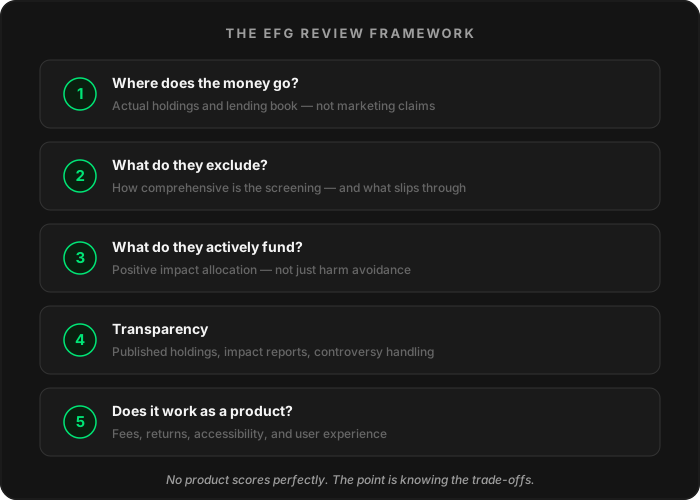
No product scores perfectly on all five. Triodos is excellent on criteria 1-4 but pays lower savings rates. A low-cost index tracker might score well on fees but poorly on exclusions. A community energy investment might be perfect on impact but illiquid.
The point isn’t to find the perfect product. It’s to know what you’re trading off — and to make that choice deliberately rather than by default.
For a deeper look at the distinction between impact investing, ESG, and SRI — and why it matters for product selection — see our guide to impact investing for beginners.
The categories that matter
Ethical financial products span distinct categories, each with different dynamics, different questions to ask, and different trade-offs to navigate.
What follows is a landscape view — our honest assessment of the major players in each category as of early 2026. Individual products will get their own detailed reviews over time. But if you want to understand the lay of the land before diving into specific choices, this is the map.
We’ve organised this by how most people actually interact with financial products: where they bank, where they invest, what funds they hold, what their pension is doing, and how they use their ISA allowance.
Ethical banks and building societies
The question most people ask first: where should I put my current account?
The key question for banks isn’t what app they have or what rate they pay. It’s where do they lend? Your current account balance, your savings — the bank puts that money to work overnight. High street banks lend it to whoever generates the best return. Ethical banks lend it to things that align with a stated mission.
Triodos is the name that comes up most, and for good reason. They’re the most transparent bank operating in the UK — you can see every organisation they lend to on their website. Lending goes to renewable energy, organic farming, social housing, arts and culture. The trade-off: limited current account features and savings rates that trail the best-buy tables.
Ecology Building Society focuses specifically on sustainable property — energy-efficient renovations, ecological new builds, community-led housing. Not a general-purpose bank, but exceptional at what it does.
Charity Bank lends exclusively to charities and social enterprises. If your savings are there, your money is directly funding the social sector.
Nationwide is a building society, not a bank — it’s owned by its members, not shareholders. That changes the incentive structure fundamentally. It’s not “ethical” in the Triodos sense, but the mutual model means profit serves members rather than extracting from them. We’ve covered why cooperative models matter in the context of building a better financial system.
Monzo and Starling are digital, convenient, and popular. But “digital” is not the same as “ethical”. Neither publishes a detailed lending policy. Being a challenger bank doesn’t automatically make you better — it just makes you newer.
| Bank | Type | Lending focus | Current account? | Savings rates | Verdict |
|---|---|---|---|---|---|
| Triodos | Ethical bank | Renewables, social enterprise, culture | Yes (limited) | Below average | Gold standard on transparency, trade-off on rates |
| Ecology BS | Building society | Sustainable property | No | Competitive | Exceptional niche, not general purpose |
| Charity Bank | Ethical bank | Charities and social enterprises | No | Below average | Your money directly funds social good |
| Nationwide | Mutual | General — member-focused | Yes (full) | Competitive | Not “ethical” labelled, but structurally better |
| Monzo | Digital bank | Not published | Yes (full) | Competitive | Convenient, not ethical by design |
A detailed comparison is coming: Ethical Banks vs High Street Banks Compared.
Investment platforms
The platform is where you buy and hold investments. Some offer pre-built ethical portfolios. Others give you the tools to build your own. The key question: does the ethical option give you genuine control, or is it a marketing tier?
Wealthify offers a dedicated “Ethical Plan” that excludes fossil fuels, weapons, tobacco, and animal testing, while positively screening for companies supporting clean energy, sustainable practices, and social good. It’s one of the more accessible entry points — low minimums, simple UX. The limitation: you don’t choose individual funds. You’re trusting their screening methodology.
Nutmeg — now owned by JP Morgan — has a “Socially Responsible” portfolio tier. It uses ESG-tilted index funds. It’s better than their standard portfolio, but “socially responsible” is doing a lot of work here. The underlying approach is ESG integration, not impact. And being owned by JP Morgan raises its own questions about how far “responsible” can stretch.
Interactive Investor gives you full DIY control with their ethical fund ACE ratings — Avoids, Considers, Embraces — to help filter. If you know what you want to buy, this is one of the better platforms. If you don’t, the choice can be overwhelming.
Hargreaves Lansdown is the UK’s biggest platform. Massive fund selection. Good research tools. No dedicated ethical tier — but you can search and filter their fund list. The platform itself is neutral; the ethics come from what you choose to buy on it.
Newer entrants like Clim8 (climate-focused) and Tickr (impact-focused) built ethical criteria into the product from day one. They’re worth watching, though some have struggled with scale and sustainability as businesses.
| Platform | Ethical portfolio type | Min investment | Annual fee | Underlying approach | Verdict |
|---|---|---|---|---|---|
| Wealthify | Ethical Plan (managed) | £1 | 0.6% + fund costs | ESG screening + positive tilt | Good entry point, limited control |
| Nutmeg | Socially Responsible (managed) | £500 | 0.75% + fund costs | ESG-tilted index | Better than default, still limited |
| Interactive Investor | DIY with ACE ratings | £25/month | Flat fee from £4.99/month | Your choice | Best for informed DIY investors |
| Hargreaves Lansdown | DIY (no ethical tier) | £1 | 0.45% (capped) | Your choice | Biggest selection, no ethical guidance |
| Clim8 | Climate-focused (managed) | £25 | 0.6% + fund costs | Climate impact | Niche and targeted, limited track record |
A full review is coming: Best Impact Investing Platforms in the UK.
Funds worth knowing about
The UK fund landscape splits roughly three ways: passive ESG index funds, actively managed ethical funds, and dedicated impact funds.
Passive ESG index trackers — like those from iShares, Vanguard, or Legal & General — are cheap and diversified. But they typically just exclude a shortlist of controversial sectors while tracking a broad index. You’re paying less, but your money isn’t doing much differently. The “ESG” version of the FTSE often looks remarkably similar to the standard FTSE.
Actively managed ethical funds apply more judgment. Liontrust Sustainable Future funds are among the most established — over 20 years of track record, clear positive impact themes, and published exclusion criteria. Royal London Sustainable funds are widely available in workplace pensions. WHEB Sustainability Fund focuses on nine sustainable investment themes with detailed impact reporting. These cost more than index trackers, but for ethical investing, active management arguably matters more than it does in conventional investing — because you’re paying someone to make judgment calls about ethics, not just market efficiency.
Dedicated impact funds like those from Triodos or Impax Asset Management go further still — investing specifically in companies and projects driving environmental and social solutions. Impax’s Environmental Markets funds have decades of track record in the clean economy transition.
One thing to watch: the FCA’s Sustainability Disclosure Requirements (SDR) are bringing new labels to UK funds — “Sustainability Focus”, “Sustainability Improvers”, “Sustainability Impact”, and “Sustainability Mixed Goals”. These should help clarify what a fund actually does versus what it claims. But the labels are still rolling out, and not all fund managers have adopted them yet.
Individual fund reviews will do the heavy lifting here. For now, the key takeaway: read the factsheet. Look at the holdings. If the top 10 positions look like a standard index with a green label, it probably is one.
Pensions
Your pension is almost certainly your largest single investment. It’s also — quietly — your biggest ethical lever.
The problem is that most people have never chosen their pension fund. Your employer picked a provider. The provider set a default fund. That default fund holds thousands of companies, including — almost always — fossil fuel producers, arms manufacturers, tobacco companies, and mining conglomerates. We’ve covered exactly what you’re inadvertently funding through default pension allocations.
The good news: you have more options than you think.
PensionBee offers a dedicated “Fossil Fuel Free Plan” that excludes companies deriving significant revenue from fossil fuels, as well as a “Shariah Plan” for those seeking Islamic finance compliance. It’s accessible, transparent, and designed for people who’ve never engaged with their pension before.
Cushon claims to be the world’s first net zero pension. It aligns portfolios with a 1.5°C pathway and excludes the most carbon-intensive industries. The approach is climate-specific rather than broadly ethical, but it’s one of the more rigorous climate-focused implementations.
Workplace pension providers like Aviva, Legal & General, and Scottish Widows now offer ESG or “responsible” fund options within their default range. The quality varies enormously. Some are genuinely re-weighted towards sustainable companies; others are minor tweaks to the standard fund with a new name. Check the holdings — if the top positions are the same as the default fund, the “ethical” switch hasn’t changed much.
SIPP (Self-Invested Personal Pension) gives you full control. If you want to choose exactly which funds your pension holds — including dedicated impact funds — a SIPP through a platform like Interactive Investor, AJ Bell, or Hargreaves Lansdown is the way to do it. The trade-off: you need to know what you’re doing, or be willing to learn.
Your pension is a decades-long commitment. The compound effect of where that money sits — what it funds and what it doesn’t — is enormous.
Ethical ISAs
An ISA is a tax wrapper, not an investment. The ethical question isn’t “is my ISA ethical?” — it’s “what’s inside my ISA?”
Stocks and shares ISAs with pre-built ethical portfolios are the most common option. Triodos offers a dedicated ethical stocks and shares ISA investing in their own impact funds — you know exactly where the money goes, though you’re limited to Triodos’s fund range. Wealthify’s Ethical Plan is available as an ISA wrapper — simple, accessible, but you don’t pick the underlying funds.
For DIY investors, any stocks and shares ISA lets you choose ethical funds yourself. The ISA is just the tax-free wrapper; the ethics come from what you put inside it.
Cash ISAs are simpler but still matter. Where your cash ISA sits determines where that money is lent. A cash ISA with Triodos means your savings fund renewable energy and social enterprise. A cash ISA with a high street bank means your savings fund whatever generates the highest return for the bank’s shareholders.
Charity Bank also offers cash ISAs where your deposits are lent exclusively to charities and social enterprises. The rates are typically below best-buy tables, but your money is doing unambiguous good.
The ISA allowance is £20,000 per year — a significant amount of capital. Whether it’s in stocks and shares or cash, choosing where that money sits is one of the more straightforward ethical decisions you can make. The sections on banks and platforms above apply directly — an ISA just makes the returns tax-free.
The red flags
Not every product that calls itself ethical deserves the label. Here’s what to watch for — the warning signs that a product’s ethics are more performative than substantive.
-
They won’t show you the holdings. If a fund or platform talks about ESG scores and sustainability frameworks but won’t let you see what they actually hold, something’s wrong. Transparency is non-negotiable.
-
The “ethical” option is the same portfolio minus three stocks. If the ethical tier removes tobacco and controversial weapons but keeps everything else — and charges higher fees for the privilege — you’re paying a premium for minimal change.
-
“Best in class” screening. This means they pick the least bad company in each sector. So you get the “best” oil company, the “best” mining company, the “best” arms manufacturer. That’s not ethics. That’s grading on a curve.
-
No published exclusion policy. If you can’t find a clear, specific list of what they exclude and why, they probably don’t have one. Vague commitments to “responsible investing” aren’t a policy.
-
Impact claims with no measurement. “Our fund supports a sustainable future” is marketing. “Our investments generated 3.2 million MWh of clean energy and avoided 1.4 million tonnes of CO2 in 2025” is impact reporting. One is a claim. The other is evidence.
-
“Carbon neutral” via offsets, not allocation. Buying carbon credits to offset a dirty portfolio is not the same as actually investing in clean companies. Offsets are the financial equivalent of paying someone else to diet on your behalf.
Where to start if you do one thing
If this all feels like a lot — the categories, the trade-offs, the screening criteria — here’s one concrete action.
Check your pension holdings.
Log in to your workplace pension. Find the name of the fund you’re in. Download the factsheet — every fund has one, look for “fund factsheet” or “fund information”. Scroll to the top 10 holdings.
If you see Shell, BP, BAE Systems, British American Tobacco, Glencore, or Rio Tinto in that list — you now know what your retirement savings are funding. Not because you chose to. Because someone chose a default, and you never questioned it.
That’s not guilt. That’s information. And information is where change starts.
Once you’ve seen what’s there, come back. We’ll help you find alternatives. That’s what the reviews on this site are for — not to sell you something, but to give you honest assessments so you can make your own informed decision.
You have more power than the system wants you to believe.
Further reading
- What Is Wrong With the Financial System? — the full case for why the system is broken
- How to Build a Better Financial System — credible alternatives that already exist
- Impact Investing for Beginners — how to grow your money while funding what matters
- Best Impact Investing Platforms in the UK — coming soon
- Ethical Banks vs High Street Banks Compared — coming soon
This is the anchor of our series on ethical investment reviews. If you want to stay informed, join the community.